
Short Biography
Magnus Penker is an internationally-renowned though leader on innovation, artificial intelligence, digitization, and business transformation. He is the CEO of Innovation 360 Group, and a speaker in prestigious global forums and events, such as – The Global Peter Drucker Forum, top ranked international business and design schools, a variety of associations and some of the world’s largest companies. Mr. Penker is currently writing a 5 Volume Series on Business Innovation titled The Complete Guide to Business Innovation and is contributing as an editor at the International Journal of Innovation Science.
As a result of these achievements he has been honored with the Business Worldwide Magazine award as the ‘Most Innovative CEO Sweden 2016’ and appointed as a Global Top 100 CEO by CEO Monthly year 2018. Additionally, he has launched 10 start-ups as well as acquired, turned around, and sold +30 SMEs all over Europe.
240
HAPPY CLIENTS
875
PUBLISHED POSTS & ARTICLES
9
PUBLISHED BOOKS
750
SEMINAR TALKS, KEY NOTES, AND WORKSHOPS
PLAY BOLD
How to Win the Business Game Through Creative Destruction
The world is changing at an unprecedented rate, entire industries are disappearing or evolving, and the planet itself is facing life-threatening challenges on the grandest scale. Change is happening, whether we like it or not.
Even if your company is doing well today, how can you prepare for sudden shifts and unimaginable risks on the road ahead? How can you plan so that you don’t just manage change, but also drive transformation—and sustainable, future-proof growth?
Magnus Penker, serial entrepreneur and Sweden’s “Most Innovative CEO” has the answers. Magnus has worked with companies across the world, from entrepreneurial scale-ups and unicorns, to Global 500’s, to help them reinvent their value propositions, optimize their operations, and scale-up winning ideas. Along the way, he has seen a few disasters as well, which serve as cautionary tales,
Here are a host of stories from a life of frontlines of business rescue, including his analysis of famous business disasters and personal experiences in saving companies on the verge of collapse. With his one-of-a-kind mix of humor, science and practical insights, Magnus Penker explains how to make continuous innovation work in the real world – and how to play bold to win the game.

Wow! Everything that Magnus says is somewhat contrary to our official positions on successful innovation. I had to read his book. I am glad that I have. His book has a freshness of ideas and a wonderful style of writing and content. Magnus has written previous books on innovation in a more formal style. But this book amounts to sitting down and listening about the logical and emotional work that goes into successful innovation.
– Philip Kotler, Dec 2020
The Complete Guide to Business Innovation (5 Volumes)
Volume 1 – published
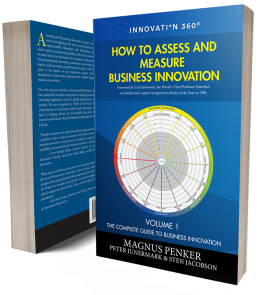
How to Assess and Measure Business Innovation
Foreword by Leif Edvinsson, the World´s First Professor Emeritus on Intellectual Capital recognized as Brain of the Year in 1998
Assessing and Measuring Innovation is part one in a 5-volume series investigating why some innovations have proven to be exponentially influential and identifying which elements matter most in transforming brilliant ideas into practical ones. Based on hard data from thousands of enterprises and penetrating insights from professional innovation consultants, this volume guides business leaders through a critical selfassessment prior to the launch of any innovative project. The InnoSurvey® introduced in this series represents the world’s largest database on business innovation.
Over the past two decades, Innovation360 founder Magnus Penker has counseled countless enterprises on making innovation profitable, executing digitization and the global implications of new business models. He was recognized as “CEO of the Year” in 2016 for his achievements in Innovation and Growth Strategies. While devoting time to helping others, he successfully launched 10 startups and turned around more than 30 businesses throughout the continent of Europe.
Innovation360’s mission is to support and strengthen the global innovation capability needed to address humanity’s grand challenges: Food, Energy, Water, Security, Global Health, Education, Environment, Poverty and Space; something we share with all our licensed practitioners as well as strive for internally. The aim is, therefore, to help 1 million+ entrepreneurs, companies, executives and scientists to become world-class innovators through our unique innovation measurement tool and database, InnoSurvey®, as a free-to-all digital online service. This is complemented by an enterprise tool and specialist services provided by our consultants, as well as licensed practitioners all over the globe.
The beauty is that the more we do, the more our licensed practitioners do and the more value we provide while earning profits at the same time. This allows us to invest even more in evidence-based innovation management and help millions of entrepreneurs to make the world a better place as they use sustainable innovation solutions to solve the grand challenges facing humanity.

Volume 5 – published
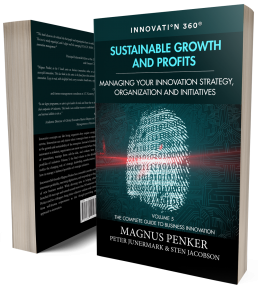
Sustainable Growth and Profits: Managing Your Innovation Strategy, Organization, and Initiatives
Innovative concepts are like living organisms—they require energy and resources to survive. Innovation can only thrive when it emerges from an organization committed to the growth and sustainability of the enterprise. Instead of thinking of cultivating an innovation in isolation, organizations are more successful when they generate a cluster of innovations, manage them side-by-side, and evaluate how they interact as a portfolio of initiatives. Volume 5, the final volume in this detailed reference series, tackles the changing role of strategy, leadership, transformation, sustainability, and how to manage a balanced portfolio of strategic initiatives.
Innovation360 founder Magnus Penker has counseled countless enterprises on making innovation profitable, executing digitization, and responding to the global implications of new business models. While devoting time to helping others, he successfully launched 10 start-ups and turned around more than 30 businesses throughout Europe. Penker and his colleagues bring their collective wisdom and contemporary examples from well-known corporations to this thought-provoking and game-changing approach to innovation.
“In our degree programme, we aim to give leaders the tools and know-how to innovate and transform their companies & industries. This book is an excellent resource to understand the external influences and internal abilities to do so.”
– Melissa Rancourt, Academic Director of Global Executive Master Degree on Strategic Design & Management at Parsons School of Design.
“This book discusses the critical role that people and organization have in making innovation happen. The text is nicely organized, and it aligns well the emerging ISO/CD 50501 standard/guidance for innovation management.”
– John Saiz, Principal Industrial Fellow at the Univ. of Cambridge and former CTO of NASA JSC.
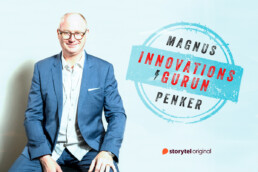
The Innovation Guru on Storytel (Swedish only)
Innovation is for everyone. I mean that in two ways. First, no one should think that this is a special talent possessed by only a few lucky individuals. Everyone can learn how to innovate successfully. It’s a science, and not a mad science like alchemy but a good science like chemistry. It takes the right combination of the right elements to innovate successfully, but once those elements are in place the company can replicate the process, over and over. No company can depend on a single great idea for very long. It requires a culture of innovation to win consistently in a rapidly changing market.
At the same time, “innovation is for everyone” means that it belongs to the whole world. Innovation can and must do far more for us than just help a single company become a bit more efficient. Our entire planet needs to think more innovatively if we hope to prevent a catastrophic future.








Global Thought Leader Insights Podcast

Trending Posts